 Jigsaw
Caribbean Island Hopping: 10 Islands and What Makes Each One Special
Turquoise shallows in the Bahamas, volcanic peaks in Saint Lucia, spice farms in Grenada and steelpan music in Trinidad: a tour of ten Caribbean islands.
The Caribbean Sea is scattered with thousands of islands, and although they all share warm water and palm trees, each one has its own character. Some are flat coral islands with endless beaches, others are steep volcanic peaks covered in rainforest. Here are ten islands and island nations, each with something that makes it unique.
1. The Bahamas: the clearest water
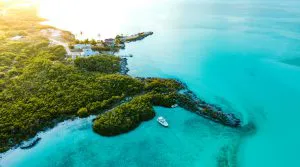
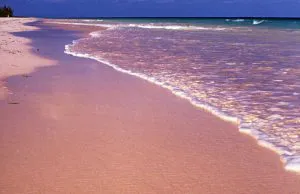
Strictly speaking the Bahamas lie in the Atlantic, but they are part of every Caribbean journey. The islands sit on shallow limestone banks, which give the sea its dazzling shades of turquoise. In the Exumas, a group of pigs swims out to meet visiting boats, and on Harbour Island the sand is tinted pink by tiny red-shelled sea creatures.
2. Cuba: music and old cars
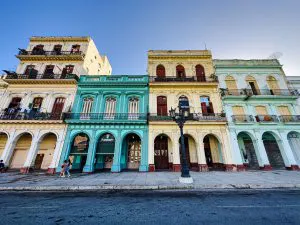
The largest island in the Caribbean is famous for Havana’s colourful colonial streets, where American cars from the 1950s still work as taxis. Inland, the Viñales Valley is dotted with steep limestone hills rising above tobacco fields.
3. Jamaica: reggae and waterfalls
The birthplace of reggae offers the long white sand of Seven Mile Beach in Negril, cliffs where brave swimmers dive into the sea, and Dunn’s River Falls, which visitors can climb hand in hand. Coffee from the misty Blue Mountains is among the most prized in the world.
4. Antigua: a beach for every day
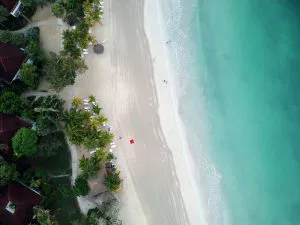
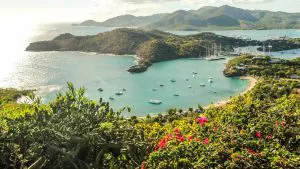
Antigua likes to say it has 365 beaches. It also has English Harbour, a former British naval base whose restored Georgian buildings, known as Nelson’s Dockyard, are a World Heritage Site. The view from Shirley Heights above the harbour is one of the finest in the region.
5. Dominica: the nature island
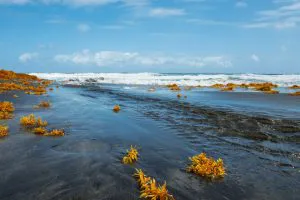
Not to be confused with the Dominican Republic, Dominica is a wild, mountainous island covered in rainforest, with hot springs, waterfalls and black volcanic sand. Its deep coastal waters are one of the few places in the world where sperm whales live all year round.
6. Saint Lucia: the Pitons
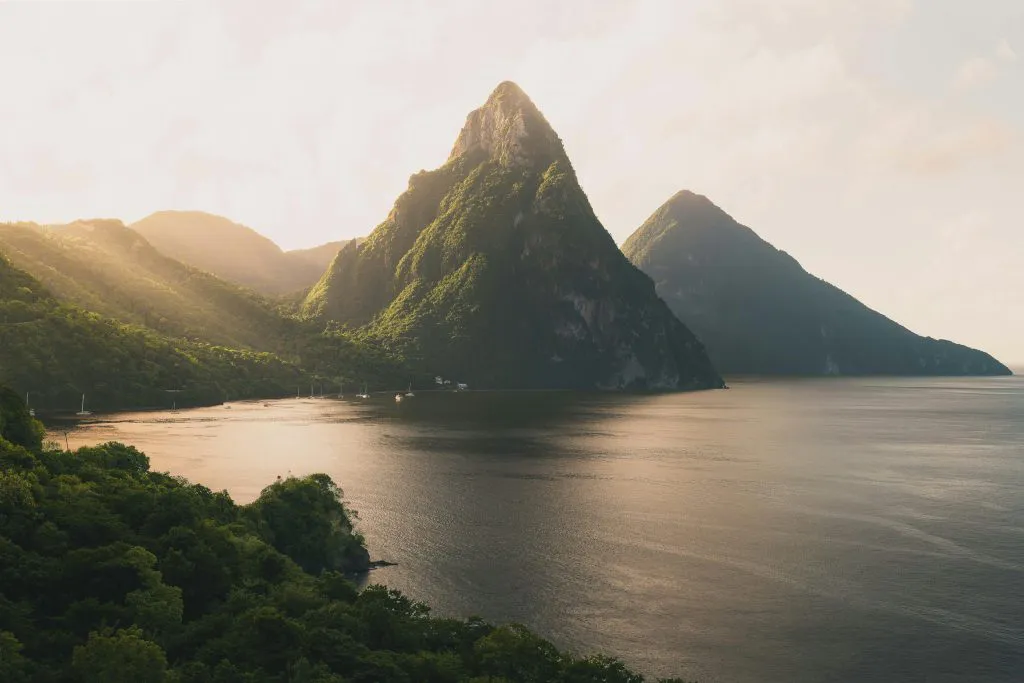
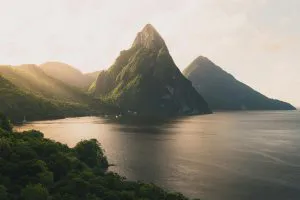
Two steep volcanic spires, Gros Piton and Petit Piton, rise straight out of the sea on Saint Lucia’s west coast and form a World Heritage Site. Nearby, the town of Soufrière sits beside a volcanic area of hot springs and steaming vents.
7. Barbados: two coasts
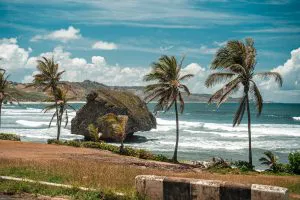
The most easterly island of the Caribbean has a calm west coast of gentle turquoise water and a wild east coast pounded by Atlantic waves. Its capital, Bridgetown, and the old garrison beside it are a World Heritage Site, and many say Barbados is where rum was first made.
8. Saint Vincent and the Grenadines: a sailor’s paradise
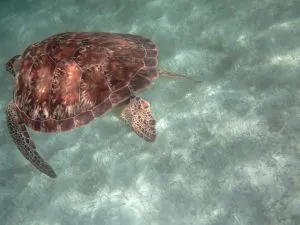
This chain of about thirty islands and cays is best explored by boat. In the protected Tobago Cays, sea turtles graze on seagrass right beside swimmers, and Bequia’s Admiralty Bay keeps an old tradition of boat building.
9. Grenada: the spice isle
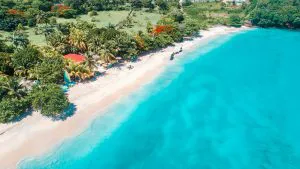
Grenada grows so much nutmeg that the spice appears on its national flag. Its capital, St. George’s, climbs the hills around a horseshoe-shaped harbour, and Grand Anse Beach curves for about three kilometres of white sand.
10. Trinidad and Tobago: carnival and scarlet birds
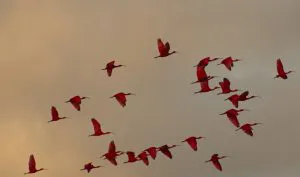
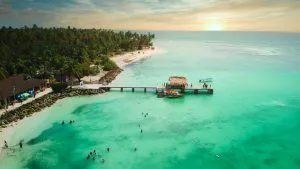
The birthplace of the steelpan and home of calypso music hosts one of the world’s greatest carnivals. At sunset in the Caroni Swamp, flocks of bright red scarlet ibises fly in to roost, and on quieter Tobago, Pigeon Point has one of the most photographed jetties in the Caribbean.
When to go
The Caribbean is warm all year, but the dry season from about December to April is the most popular time to visit. The Atlantic hurricane season runs from June to November, with the greatest risk usually from August to October. Islands in the far south, such as Trinidad and Tobago and Grenada, are less often in the path of hurricanes.
Wherever you choose, respect the reefs and the wildlife: do not touch coral, keep your distance from turtles and use reef-safe sunscreen. Or simply travel from island to island by puzzle, with no suitcase needed.