 Jigsaw
Where and When to See the Northern Lights
What makes the aurora glow, the best months and hours to look for it, and six of the best places on Earth to watch it, from Tromsø to Yellowknife.
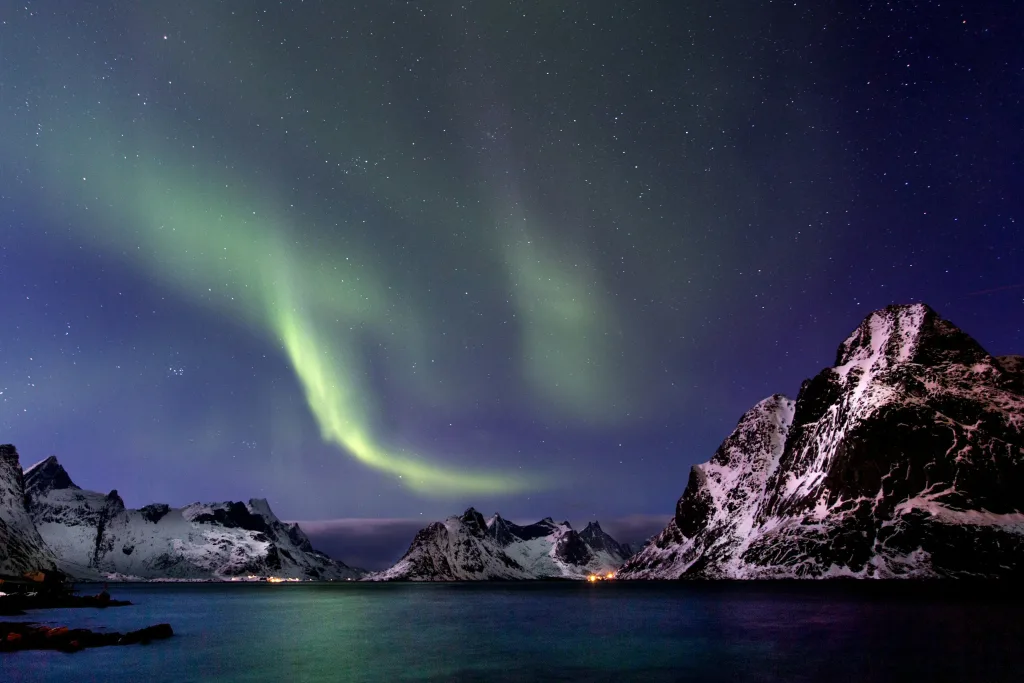
Few sights in nature are as unforgettable as the northern lights: curtains of green light that ripple across a dark winter sky, sometimes edged with pink or violet. Their scientific name is the aurora borealis, and seeing them takes a little planning. Here is what causes them, when to look, and where on Earth your chances are best, with puzzles from each place.
What makes the sky glow
The Sun constantly sends out a stream of charged particles called the solar wind. When these particles reach Earth, our planet’s magnetic field guides many of them towards the polar regions. There, high in the atmosphere, they collide with atoms of oxygen and nitrogen and make them give off light, much like the gas in a neon sign.
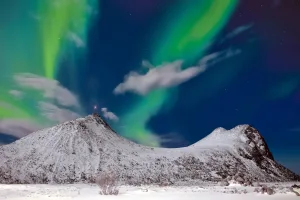
The colour depends on the gas and on the height. Oxygen about 100 to 250 kilometres up gives the familiar green, while oxygen even higher can glow red. Nitrogen adds touches of blue and purple, often along the lower edge of a bright display. In the Southern Hemisphere the same thing happens around the South Pole, where the lights are called the aurora australis, or southern lights.
When to look
Auroras happen all year round, but you need darkness to see them. In the far north the summer nights are too bright, so the season runs roughly from September to early April. Many aurora watchers like the weeks around the equinoxes in September and March, when the nights are long but not yet bitterly cold.
The lights are often strongest in the hours around midnight, although they can appear at any time after dark. Two other things matter just as much: a clear sky, and distance from town lights. A display that is faint from a brightly lit street can be breathtaking from a dark lakeshore a few kilometres away. Aurora forecasts, based on measurements of the solar wind, tell you when activity is likely to be high.
The best places to see the northern lights
Auroras are most frequent under the auroral oval, a ring around the magnetic North Pole that passes over northern Scandinavia, Iceland, northern Russia, Alaska and northern Canada. These places lie close to it, and each of them is in our puzzles.
Tromsø and the Lofoten Islands, Norway
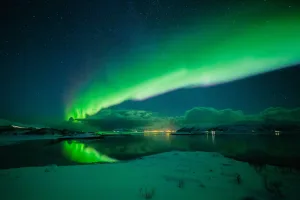
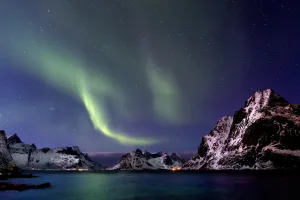
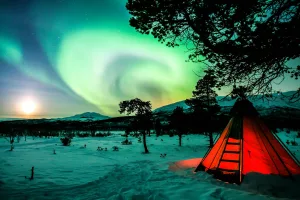
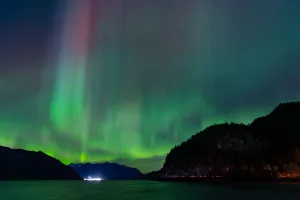
Tromsø, about 350 kilometres north of the Arctic Circle, is one of the most popular aurora destinations in the world, with fjords and mountains all around the city. From late November to mid-January the sun does not rise there at all. Further south-west, the Lofoten Islands rise from the sea in a wall of sharp peaks, and thanks to the Gulf Stream their winters are surprisingly mild.
Abisko, Sweden
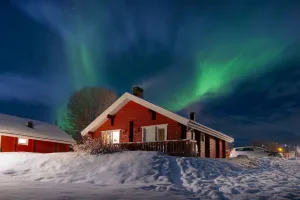
Abisko, in Swedish Lapland, lies in a rain shadow behind the mountains, so its sky is clear more often than elsewhere in the region. A chairlift carries visitors up Mount Nuolja to an aurora sky station high above the valley.
Finnish Lapland
In the north of Finland the aurora can be seen on about 200 nights a year. The Finnish word for it, revontulet, means “fox fires”, from an old tale of a fire fox whose tail sweeps the snow and sends sparks into the sky.
Iceland
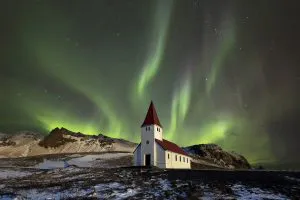
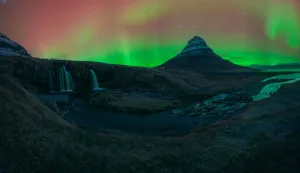
Iceland lies right beneath the auroral zone, and on a clear night the lights can appear almost anywhere outside the towns. Favourite spots include Kirkjufell, the steep “Church Mountain” on the Snæfellsnes peninsula, and the dark lava fields around Lake Mývatn in the north.
Yellowknife and northern Canada
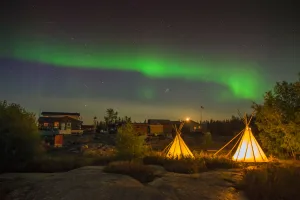
Yellowknife, the capital of the Northwest Territories, stands on the shore of Great Slave Lake directly under the auroral oval. Its flat land and dry, clear winters make it one of the best places in North America to watch the sky. A large part of Canada lies under the oval, so the lights also dance over the lakes and mountains of the Yukon and northern Quebec.
Naryan-Mar, Russia
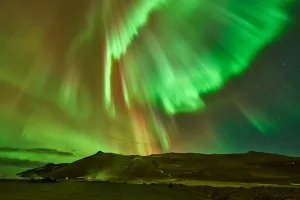
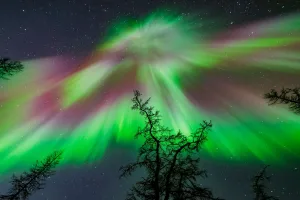
In Russia’s far north, the small town of Naryan-Mar stands on the Pechora River in the tundra of the Nenets region, not far from the Barents Sea. When an aurora is directly overhead, its rays seem to meet at a single point, a shape known as a corona.
Tips for your first aurora night
- Dress for the cold: you may stand outside for hours, often well below freezing.
- Give your eyes 15 to 20 minutes to adjust to the dark, and keep your phone screen dim.
- A faint aurora can look almost grey to the eye, but a camera on a tripod with a long exposure shows its colours.
- Be patient: displays often come in waves, with quiet spells in between.
See the lights in puzzles
If a trip north is not on your calendar this winter, you can still watch the sky glow piece by piece. All our aurora puzzles, from Iceland and Norway to Canada and Russia, are together on the Northern Lights page.