 Jigsaw
Greek Mythology Places You Can Visit
Real places from the Greek myths that you can still visit: Mount Olympus, the Acropolis of Athens, Cape Sounion, Delphi, Olympia, Knossos on Crete, Mycenae, Troy, Delos, Epidaurus, Rhodes and Aphrodite's Rock in Cyprus, with the stories told about each one.
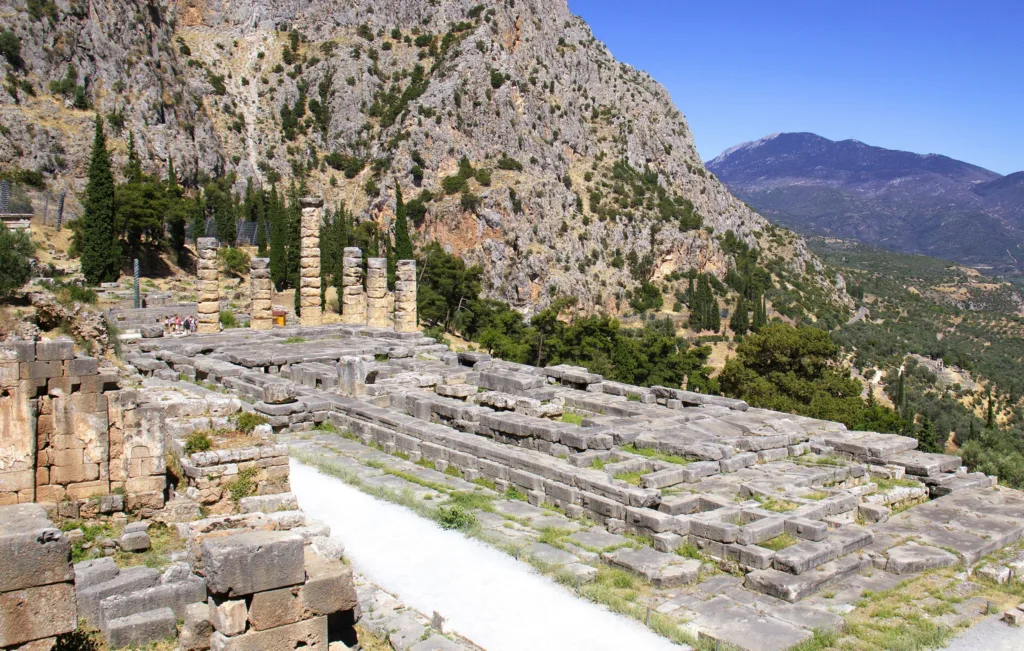
The Greek myths were not set in an imaginary world. The ancient Greeks placed their gods and heroes in real landscapes, and many of those places can still be visited: the mountain where the gods lived, the temple of the oracle of Apollo, the palace of the Minotaur and the walls of Troy. Here are the most famous places of Greek mythology, with the stories told about them and a puzzle of each.
In short: the best places to see Greek mythology are Mount Olympus, the Acropolis of Athens, the Temple of Poseidon at Sounion, Delphi, Olympia, the palace of Knossos on Crete, Mycenae, Troy in Turkey, the island of Delos, the sanctuary of Epidaurus, Rhodes and Aphrodite’s Rock in Cyprus.
Mount Olympus, home of the gods
At 2,918 metres, Mount Olympus is the highest mountain in Greece, and in the myths its cloudy summit was the home of the twelve Olympian gods, ruled by Zeus. It became Greece’s first national park in 1938, and walkers can climb it from the town of Litochoro in two days, sleeping in a mountain refuge on the way.
Athens: Athena’s city
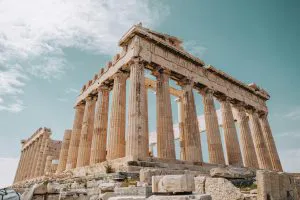
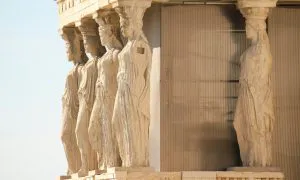
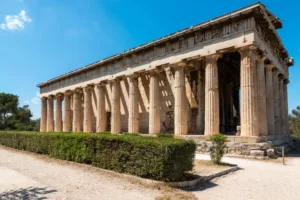
According to the myth, Athena and Poseidon both wanted to be the patron of Athens. Poseidon struck the rock of the Acropolis with his trident and a spring of salt water appeared; Athena planted an olive tree, and the people chose her gift. The Erechtheion, with its porch of Caryatids, was built on the spot where the contest was said to have taken place, and the Parthenon, finished in 432 BC, was the temple of Athena herself. Below the Acropolis, the Temple of Hephaestus, the god of fire and metalwork, is the best-preserved ancient temple in Greece.
Cape Sounion and the Aegean Sea
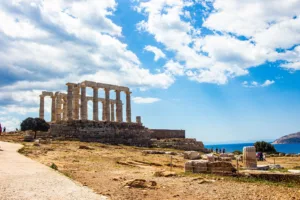
At the southern tip of Attica, the Temple of Poseidon stands on a cliff high above the sea. The myth says that King Aegeus waited here for his son Theseus to return from Crete. Theseus had promised to change his black sails for white ones if he had killed the Minotaur, but he forgot, and Aegeus, believing his son was dead, threw himself into the sea, which has been called the Aegean ever since.
Delphi, the navel of the world
Zeus is said to have released two eagles from opposite ends of the world, and where they met, at Delphi, was the centre of the Earth, marked by a stone called the omphalos, or navel. Apollo killed the serpent Python here and founded his oracle, where the priestess Pythia gave the god’s answers to kings and cities from all over the Greek world. The ruins of the Temple of Apollo stand on the slopes of Mount Parnassus, above a valley of olive trees.

Olympia, the sanctuary of Zeus
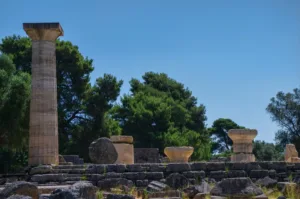
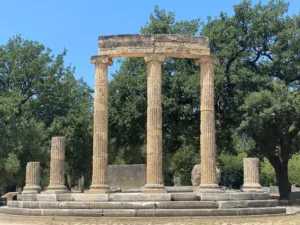
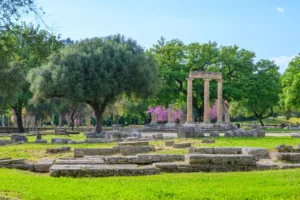
Olympia was the great sanctuary of Zeus, and from 776 BC the Olympic Games were held here in his honour every four years. Winners received a wreath cut from a sacred wild olive tree, and the temple held the gold and ivory statue of Zeus by Phidias, one of the Seven Wonders of the ancient world. Today the Olympic flame for every Games is still lit here, in front of the Temple of Hera.
Knossos and the Minotaur
On Crete stands the palace of Knossos, the centre of the Minoan civilisation more than 3,500 years ago and, in legend, the home of King Minos. Minos kept the Minotaur, half man and half bull, in a labyrinth built by the craftsman Daedalus, until Theseus killed it and found his way out with the thread of Ariadne. Daedalus and his son Icarus later escaped from Crete on wings of feathers and wax. The archaeologist Arthur Evans excavated the palace from 1900 and rebuilt parts of it, such as the red columns of the north entrance.

Mycenae, the city of Agamemnon
Mycenae, in the Peloponnese, was the most powerful city of Bronze Age Greece, and in Homer’s stories it was the home of King Agamemnon, who led the Greek army against Troy. Its walls are made of stones so huge that later Greeks believed only the giant Cyclopes could have moved them. Visitors still enter through the Lion Gate, built around 1250 BC, and in 1876 Heinrich Schliemann found gold masks in the royal graves here.

Troy
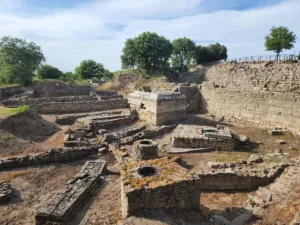
The city of the Trojan War stood near the Dardanelles in today’s Turkey. In the story, the Greeks besieged Troy for ten years to bring back Helen, the wife of King Menelaus of Sparta, and finally took it by hiding soldiers inside a wooden horse. Since the 1870s, archaeologists have found the remains of at least nine cities built one on top of another on the hill of Hisarlik, and one of them may be the Troy of the legend.
Delos, birthplace of Apollo and Artemis
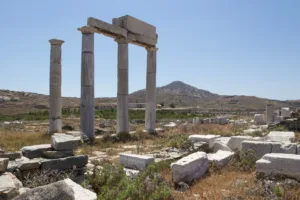
In the myth, the goddess Leto could find nowhere to give birth to the twins of Zeus until she reached Delos, then a floating island, which was fixed to the sea floor so that Apollo and Artemis could be born there. Delos became one of the holiest places in Greece, and today the whole tiny island, near Mykonos, is an open-air museum of temples, houses and the famous marble lions.
Epidaurus, the sanctuary of Asclepius
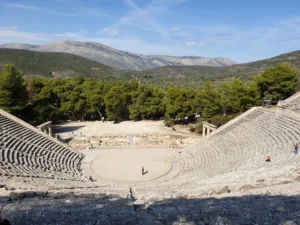
Epidaurus was the main sanctuary of Asclepius, the god of medicine, a son of Apollo, where the sick came from all over Greece to be healed. Its theatre, built in the 4th century BC for about 13,000 people, is famous for its acoustics: a coin dropped in the centre can be heard in the top rows. Ancient plays are still performed here every summer.
Rhodes, the island of Helios
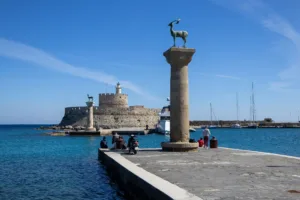
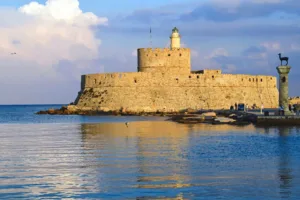
Rhodes was the island of the sun god Helios, and around 280 BC its people raised the Colossus of Rhodes, a bronze statue of Helios more than 30 metres tall and another of the Seven Wonders. It stood for only about 54 years before an earthquake brought it down. Today two bronze deer stand on columns at the entrance of Mandraki harbour, where legend says the Colossus once stood.
Aphrodite’s Rock, Cyprus
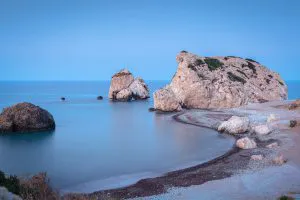
Hesiod tells that Aphrodite, the goddess of love, was born from the foam of the sea, and the people of Cyprus say she came ashore at Petra tou Romiou, a sea stack on the coast near Paphos. Her most famous sanctuary stood nearby, at Palaepaphos, and pilgrims came to it from across the ancient world.
Questions people often ask
Can you climb Mount Olympus?
Yes. The usual route starts at Prionia above Litochoro and takes two days, with a night in a mountain refuge. The highest summit, Mytikas, needs a short rock scramble.
Was Troy a real place?
Yes. The ruins of Troy lie at Hisarlik in north-west Turkey and have been a UNESCO World Heritage Site since 1998. Whether the Trojan War happened as Homer tells it is still debated, but the city was real and was destroyed several times.
Where was Zeus born?
In the myth, Zeus was born in a cave on Crete, where his mother Rhea hid him from his father Cronus. Both the Diktaean Cave and the Idaean Cave on Crete claim to be the place.
Test yourself on the myths
How well do you know the gods and heroes? Try our Greek Mythology Quiz, or follow the Seven Wonders of the Ancient World journey from Olympia to Rhodes.